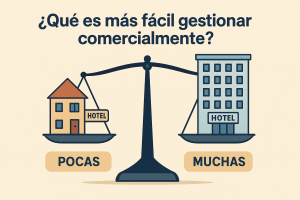


Sometimes I stop to look at my inbox and I’m constantly amazed. It seems an unwritten rule has taken hold in our industry: if you have a group, a membership card, or an association with many names on a list, you automatically qualify for a discount at a golf course or a luxury hotel.
It makes me think. At what point did theoretical volume become more important than actual service? This is a professional reflection on the value, price, and sustainability of our business.
Numbers don’t lie (even if we want to ignore them)
Often, when someone asks for “a mere 10%,” they’re unaware of the seismic impact it has on profitability. I like to bring this down to earth with cold, hard numbers, because feelings don’t pay salaries or cover green maintenance costs.
The Mathematics of Profitability
Let’s imagine we operate with a 20% profit margin (after deducting operating costs, personnel, and supplies):
- If you apply a 10% discount: To earn exactly the same as before, you have to sell twice as much! (100% more volume).
- If they ask for a 15% discount: You need to multiply your sales by four to maintain the same profit.
Is that bus company that “promises” so much really going to fill my hotel four times more?
We’re working double or quadruple the effort, wearing down the facility and stressing the team, just to stay where we were. That’s not business, that’s volunteering.
My position: From “discount” to “alliance”
Don’t get me wrong. I firmly believe in synergies, but a true alliance must have clear benefits for both parties. Anything less is giving away your brand’s prestige.
If an organization wants preferential treatment, the rules must be clear and stipulated in a contract. For me, this is the professional path:
- Prepaid Volume Commitment: Want 10%? Perfect, buy a quota of 100 green fees or 50 rooms in advance. The risk is shared, the benefit is justified.
- Contractual Events: Don’t sell me “potential clients.” Let’s close a calendar of annual events with a guaranteed deposit. That’s a business relationship, not a statement of intent.
- Exchange of Real Value: If there’s no money upfront, there has to be an equivalent asset. A targeted marketing campaign with real metrics or access to an exclusive database.
Less noise, more value
At the end of the day, what I’m certain of is that the customer who comes solely looking for a discount is the first to complain and the last to be loyal.
In the high-end golf and hospitality sector, we sell experiences. And excellence comes at a price that can’t be lowered simply because someone has a list of names that might—just might—remember us someday.
Final thought: I prefer a course with 40 players who value design and service to one with 80 who are only there because “it was cheap.” In the end, quality is always more profitable than an empty discount.